
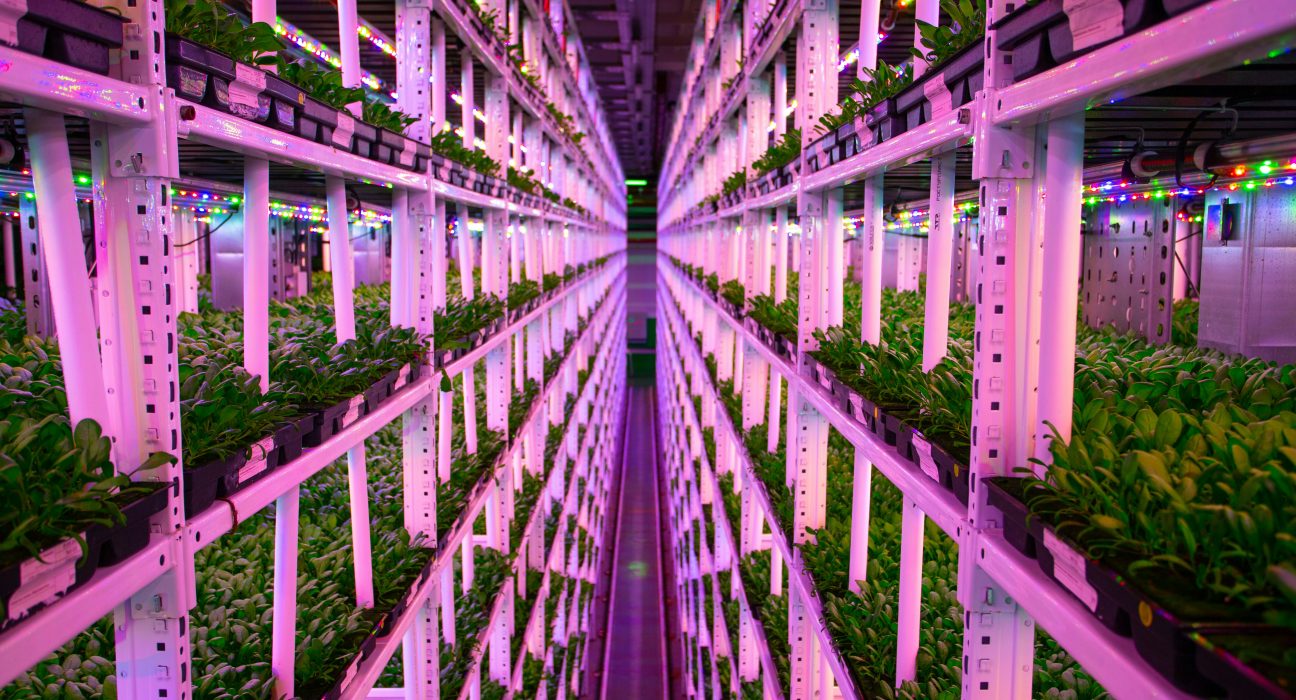
Precision vertical farming is reshaping long-held assumptions about agriculture. By combining data analytics, automation, and controlled-environment growing, this approach allows crops to be produced indoors in stacked layers, often using hydroponic or aeroponic systems instead of soil.
Rather than relying on weather or seasons, vertical farms create tightly managed environments where temperature, humidity, light, nutrients, and carbon dioxide levels are continuously adjusted. This precision enables crops to grow faster and more consistently, independent of climate or geography.
Growing More with Fewer Resources
One of the strongest advantages of vertical farming is resource efficiency. Compared with conventional outdoor agriculture, these systems can reduce water use by up to 90 percent by recirculating nutrients and capturing excess moisture. Because crops are grown in sealed environments, pesticide use can be almost eliminated, improving food safety and reducing chemical runoff.
Stacked growing also dramatically increases yield per square metre. In dense urban regions where arable land is limited, vertical farms offer a way to produce fresh food close to consumers, cutting food miles, reducing spoilage, and strengthening local supply chains.
Urban Farming and Supply Chain Resilience
Across Asia, Europe, and North America, vertical farms are increasingly appearing inside cities, repurposing warehouses, rooftops, and unused industrial spaces. This proximity shortens supply chains and makes food systems more resilient to disruptions caused by climate change, extreme weather, or global logistics shocks.
During periods of transport delays or agricultural losses, indoor farms can continue producing leafy greens and herbs year-round. For cities concerned with food security, this localised production model offers strategic value beyond pure efficiency metrics.
The Energy and Economics Challenge
Despite its promise, precision vertical farming has faced significant setbacks. Many early ventures struggled with high operating costs, particularly energy consumption. Indoor farms depend heavily on LED lighting, climate control, sensors, and automation systems, all of which require constant electricity.
When energy prices rise, profit margins shrink quickly. Vertical farms also compete with traditional agriculture, which benefits from free sunlight and inexpensive land. Scaling operations has proven difficult, and several high-profile companies have downsized or shut down after failing to reach sustainable economics.
These challenges highlight a key lesson: technological efficiency does not automatically translate into financial viability.
A Shift Toward Smarter, Smaller Models
The industry is now entering a more grounded phase. Instead of large, capital-intensive facilities, newer models focus on modular, smaller-scale farms tailored to local demand. Many operators are concentrating on premium, fast-growing crops such as leafy greens, herbs, and microgreens, where freshness and consistency justify higher prices.
Others are integrating renewable energy, waste-heat recovery, or hybrid greenhouse designs that combine natural sunlight with controlled environments. These approaches reduce energy dependence while retaining many benefits of indoor farming.
Innovation with Limits and Lessons
Precision vertical farming demonstrates that food security and sustainability can advance together, but only when innovation is paired with realistic business models. Saving water, land, and chemicals is meaningful, yet energy use, scale, and market positioning ultimately determine long-term success.
The farms of the future may not be fully enclosed skyscrapers filled with robots. Instead, they are likely to be thoughtfully designed systems that blend technology with local conditions, renewable energy, and economic pragmatism. In doing so, vertical farming can evolve from a bold experiment into a durable part of a more resilient global food system.